Saturday, December 3, 2016

Mediocre Movie Month 2016: Some Thoughts on "Manborg"

Look at all the laurel wreaths along the bottom!
The true mark of quality.
Manborg (2011)

Directed by Steven Kostanski
Produced by Steven Kostanski
Written by Steven Kostanski, Jeremy Gillespie

Starring Matthew Kennedy, Adam Brooks, Meredith Sweeney, Conor Sweeney, Ludwig Lee

Budget: $1,000 (Canadian)

Nostalgia is kind of played out.

"But Dylan," you say, "you're just repeating yourself from the other day in an attempt to draw some cheap chuckles!"

Right you are, hypothetical strawman. But speaking of segues, let's talk about what happens when the inmates begin running the asylum.

Over the past five years or so, there have been a rash of films, television shows, and other media which aim to recapture the tone of science fiction as people remember it back in the 80s. The first time I truly noticed this was with J.J. Abrams's 2011 Spielberg love-letter Super 8. Depending on who you ask, it was either a functional tribute to films like ET and Close Encounters of the Third Kind, or a try-hard attempt that felt like a cheap imitation rather than a true homage.

This trend has really picked up recently, what with the success of the internet short-film Kung Fury, Netflix series Stranger Things, and goofy gore-fest Turbo Kid. That list is by no means exhaustive, but there's a reason I chose those three specific works: each of them managed to capture a specific tone while adding its own voice to the chorus shouting its way into the abyss.

Manborg seems to have slipped under the radar, and I think I understand why: restraint can be a wonderful thing.

At roughly 71 minutes, Manborg is by no means an epic. It tells the story of...well, Manborg. We start with a recounting of the final days of Earth's war against Count Draculon and his legions of Hellborgs as they invade and conquer the planet. Manborg (unnamed before his transformation) is killed by Count Draculon after the villain drinks his brother's blood. Uncounted years later he wakes up, having been transformed into a half-man, half-borg, all-hero. He teams up with a squadron of specialized heroes, including martial artist #1 Man, Aussie gun-toter Justice, and knife-babe Mina. These four fighters escape Draculon's clutches and wage a guerrilla war against the legions of Hell itself.

Sound familiar? It should, because the entire movie comes across as a very deliberate attempt to ape the Toy Line adaptations of the 80s, where groups of specialized weirdos with appropriately distinguishable characteristics take on an equally-marketable bad guy.

Look at that articulation!
Also, this is within the first two minutes.
There are certain things the movie does that I really, really like. The bad guys, when not played by rubber-masked extras, are stop-motion with surprising quality. There's a...not-quite-film grain filter overlaid over the entire movie that gives it the general appearance of a Command & Conquer cinematic, but after the first few minutes it blends into the rest of the movie with surprising ease.

And roughly 5 minutes later.
At least, I thought it was easy. Really, whether you enjoy this movie relies entirely on your level of tolerance, because this movie is most definitely not for those who demand crisp, high-def action movies. The production not only relies on greenscreen, it wallows in it. Visual effects are bare-boned, with just enough resolution to get things done. Sound effects for Manborg's whirr-stomp-gearclicks are recognizable to anyone who's downloaded a soundpack from a public domain website. Every single line of dialogue has been obviously ADRed over...

As a passion project put on for a shoestring budget with a production team obviously invested in making the best possible film they could, Manborg succeeds on pretty much every level, in my opinion. If you have a soft spot for goofy action schlock, it's worth checking out. Of course, at 71 minutes long it drags at certain spots, and serves as a fair example of why something like Kung Fury still holds the crown as one of the best nostalgia-kings; sometimes pastiches need to practice restraint.

The Man
Not shown: the jpeg compression on all the text
What surprised me most was the humor present at certain points of the film. The character of the Baron, commandant of Draculon's prison full of arena fighters, has several very funny moments where he's trying to flirt with Mina and the delivery, despite the low-articulation mask, works purely based on the voicework. Throughout the Baron proved to be the funniest part of the movie, with the exception of three lines from the end of the movie delivered by Manborg's brother's ghost (it makes sense in context).

Surprisingly, some of the composition and digital effects are actually serviceable. There's a hoverbike chase scene at the halfway point that's better put-together than most high-budget chase scenes today. There's some legitimate attempts to making the world look like a post-apocalypse, and the character prosthetics and makeup are pretty passable. Manborg himself looks fine, considering it's mostly just wires and metal slapped on a harness.

Finally, the gore and animation effects are pretty good for having such a small team and low budget. Various stop-motion baddies are integrated into scenes with live-action actors, and though the goofy filter is off-putting at first, I got over it pretty quick and admired the labor that went into this.

The Borg
The movie drags on, and its length is really the only mark I would hold against it. While Turbo Kid manages to maintain its momentum for the majority of its run and Kung Fury has a really good cheese-to-minute ratio, I can easily see Manborg wear out its welcome for those without a pretty high tolerance for goofball low-budget nonsense.

The Hero
Interestingly enough, Steven Kostansky's got a fairly impressive IMDB profile, with special effects work done on large-budget works like Suicide Squad and Mortal Instruments. Considering that list, alongside other movies directed by special effects and stunt coordinators (I'm looking at you, John Wick), maybe we should stop letting directors...direct.

Finally, there's a fake trailer after the end credits for a movie called Bio-Cop about a cop who's been made immortal...by making it so he can't die, no matter what happens. It's about five minutes long, and if you can find only a single thing to watch from this review, watch that.

Verdict
Does this look like something you'd enjoy?

Then go for it.

Friday, December 2, 2016

Mediocre Movie Month 2016: Some Thoughts on "Gods of Egypt"

Definitely not Stargate
Gods of Egypt (2016)

Directed by Alex Proyas
Produced by Basil Iwanyk, Alex Poryas
Written by Matt Sazama, Burk Sharpless

Starring Nikolaj Coster-Waldau, Brenton Thwaites, Chadwick Boseman, Elodie Yung, Courtney Eaton, Gerard Butler, Geoffrey Rush

Budget: $140M

Let's jump right in, shall we?

Gods of Egypt is the best live-action video game I've ever seen. That could really function as all the review you need, because there's very little here of any substance. Suffice to say, the entire movie feels like a Blizzard cinematic they would put before the Egyptian-themed World of Warcraft expansion.

In a fantasy version of Egypt where gods are real and everybody's white, Bek (Thwaites) is a mortal thief who's got all the powers of a protagonist at his disposal. We spend just enough time with him and his lover, Zaya (Eaton) to learn he's a nice guy and she's a nice girl and they're both nice together.

Turns out Osiris is abdicating the throne of Egypt and wants his son, Jaime Lannister Horace Horus (Coster-Waldau) to follow after. Just as the crown is passing on, Set (Butler), Horus's uncle, shows up out of the desert and does the evil uncle thing where he attacks the heir and declares himself king. Horus and Set fight a bit, and it's made abundantly obvious this was one of those movies made for 3D, because the direction is flat as a fitting analogy.
Neat. Also, what?

And this is where things go off the rails. After locking blades for a bit, Horus and Set back off, burst into flame, and transform into giant metal animals.

After this bit of nonsense, Set rips Horus's eyes out of his skull and makes Egypt great again. Years later Bek steals one of the eyes back, visits Zaya at her work, and then watches her die after getting shot by her boss, Urshu (Rufus Sewell). After half of the speaking female cast gets stuffed into a refrigerator kidnapped by Anubis to serve as a plot motivator, the boys set out to save the day.

Long story short, there's a trip to the underworld, Butler kills a bunch of people and turns into Voltron, and there's a whole bunch of moderate-quality CGI covering up a reskinned telling of Marvel's Thor. It feels like a bunch of kids got ahold of third-rate Egyptian-themed Beastmorphers and told the only story they could think of. Though the first 45 minutes or so have some mild entertainment, it's two hours long.

I wonder if he ever gets tired of killing Jews.
Overall the acting is...fine, but incredibly inconsistent. Butler chews the scenery with the same vigor as Leonidas. Thwaites and Coster-Waldau are doing their best with the script they've been given. Rush (complete with braided white rat-tail and white robe) and the rest just seem disinterested. With the direction hampered by the requirements of filming for 3D, it's tough to really care over the full length of this slog. If Rufus Sewell wasn't playing an asshole, I would have checked out really, really early.

The Mildly Entertaining
Overall the production seems sincere, if misguided. The director used some nice forced-perspective tricks to highlight the height differences between the mortals and gods, the scenes with multiple Thoths (Boseman...Bosemen?) were shot multiple times, then superimposed, and I guess I have to respect the director attempting to make an original fantasy movie free of franchise restrictions.

Alongside the above, the design and creativity behind some of the visuals is really, really cool. I fully admit to being a shameless geek where worldbuilding is concerned, and Egyptian-themed fantasy is not done terribly often. The divine and mythical aspects of the film are actually pretty cool, and it's such a shame they are wasted here. There's a sort of ancient-aliens visual aesthetic to the entire movie that's, unfortunately, never really expanded upon.

Way cooler than some stupid eight-legged horse.
In particular, Hathor's (Yung) teleport involves getting dragged through the Underworld by demons, represented by eternal passageways of grasping, writhing arms. That's more metal than most stuff you'd find in Gods of Norway. Also, the gods bleeding gold is kind of cool, even if it looks like paint at times.

The Obviously Problematic
Yeah, it would be disingenuous of me to not mention how everybody in this movie, except the all-wise teacher and a single mean goddess, is white. There's been plenty said on this, from Forbes to BET, and I don't really know that I can add a fresh take to it. After the criticisms from all these channels the director and Lionsgate actually issued apologies, which were generally greeted with "eh, alright." As of yet it's too early to see whether they'll actually follow through on doing better, but one can always hope. At least Boseman has Black Panther coming up.

But let's be honest, if you're going to make a movie about (even fictionalized) Egyptian gods and cast a predominantly white cast, there's no one to blame but yourself.

Otherwise the movie suffers from your usual blockbuster problems: poor screenplay, over-reliance and under-performance of CGI, and weak story decisions that break your immersion, shallow though it may have been.

The Batshit Insane
Praise the sun \[T]/
Here's some gifs of Geoffrey Rush flying a space gondola while shooting a chaos-snake with a spear made out of sunlight.

No, really.


This was released in theaters.
I think this honestly could have been the start to a really fun cinematic universe. Have a movie per pantheon, then have them team up to take on alien gods or something. Or, you know, you could just adapt K.A. Applegate's Everworld, but that's never going to happen.

One final note, this movie strongly reminded me of Steven Brust's novel To Reign in Hell, which is essentially a science-fiction / fantasy retelling of Lucifer's fall. It's definitely worth checking out.

Verdict
Not worth the time. Watch clips on Youtube if you're intrigued, but you shouldn't sit through the entire thing.

Tomorrow: 50% man. 50% borg. 100% justice. I think, I haven't ever heard of this one before.

Thursday, December 1, 2016

Mediocre Movie Month 2016: Some Thoughts on "Cell"

More "Inspired by" than "Based on"
Cell (2016)

Directed by Todd Williams
Produced by Richard Saperstein, Michael Benaroya, Brian Witten
Written by Stephen King, Adam Alleca

Starring John Cusack, Samuel L. Jackson, Isabelle Fuhrman

Budget: $Anemic

Zombies are played out.

Wow, Dylan, what a brave opinion, especially for someone who inhabits the contrarian circles of the internet where things lose their appeal the minute anyone finds out about them!

But damn, with The Walking Dead slumping towards an 8th season, the bizarre necrophilia love-letter that was Warm Bodies, and countless other media about the not-quite-dead, it's hard not to declare the entire thing a fad at the end of its lifecycle.

But I'm not the first person to say this, and the trend shows little indication of stopping, so here we are.

In addition to a zombie movie, this is also an adaptation of a Stephen King novel of the same title, which has widely been declared his worst work in recent memory. Of course, this was the first Stephen King novel I ever read and I enjoyed it well enough for its unflinching portrayal of an apocalypse, pragmatic characters, and interesting twists on the zombie genre.

And in classic King Adaptation style, the movie evens out the highs and lows of the novel into a puddle of shuffling, moaning "meh."

We start with Clay (referred to hereafter as Cusack, because let's be real) at an airport. The opening credits play for a bit over shots of crowds of people with literally (actually literally, not for emphasis) everybody on his or her cell phone. Cusack runs out of battery (his phone, not him) and he looks for a charger.

If you're playing the Stephen King Drinking Game, we're already at two shots for a main character who's an artist, and an unexplained, evil world-wide phenomenon. By the end of the movie you'll suffer liver damage, but that's par for the course nowadays.

Where's my high-budget Toxic Avenger reboot?
Cusack is hanging around Lloyd Kaufman (of Troma Pictures! Shame he's here.) when everybody on their cell phone starts freaking out and murdering each other.

And this is pretty much entirely what you need to know about the story: cell phones make you into a zombie.

Cusack runs around, watches the obligatory early-Apocalypse scene destruction (murder, screaming, a crashing airplane), gets chased into the subway, and meets Samuel L. Jackson, playing middle-aged, white, pudgy, flamboyantly gay Tom McCourt. Oh, wait, no, he's playing Samuel L. Jackson.

Now, there's a part of me that says a movie adaptation should be isolated from its book/theatre/theme park roots, but let's be honest, that's not the way the real world works. It might just be me, but I think some accuracy and faithfulness to the source material is required, otherwise why would you bother except to capitalize on an existing intellectual property - oh.

Anyway, Cusack and Jackson run through a soundstage set to look like burning New York, meet the obligatory young female, and wander into the wilderness. The movie follows the standard zombie movie procession:

1. Disastrous beginning with explosions, blood, and screaming.
2. Flight through ruined city, encounter with zombie horde, escape into the wilderness.
3. Murder, but not really because they're zombies.
5. Learn how the zombies tick. Turns out the mysterious cell phone signal reboots human evolution and now everybody's turning into a psychic hive-mind that broadcasts its own radio signals?
4. Meet the B-Team, watch them die one-by-one.
5. Meet the C-Team, watch one die, watch the rest escape.
6. White Male protagonist goes on by himself, fails, dies and/or becomes a zombie.

THE END. Damn it.

"Alright John you're concerned because cell phones are
turning everyone into murder-psychos."
"..."
"Good enough! Cut!"
Overall this bears the standard hallmarks of a half-assed Stephen King adaptation. The acting across the board is mediocre, but special attention should be paid to how many facial expressions Cusack makes throughout. With his long hair and constant look of mild concern, I began to wonder if he was fronting on Nicolas Cage's turf. While I'm always down for competition within an industry, I can only think of one ending for that particular Cage Match.

That's pretty much the only comment I have on the acting. Jackson is fairly forgettable beyond his standard hard-edged persona, but I didn't catch a single "mother-fucker" throughout, so I consider that a waste. They're really the only two actors with any sort of prior career, but I feel compelled to recognize the early zombie hordes for their particularly restrained portrayal of rage-zombies. At one point early on Cusack is getting chased down a set of airport escalators (the really steep ones that lead to a subway) and you can clearly see the zombies behind him use the hand rails. There was a great spot for some physical craziness where they throw themselves down the stairs, but, you know, that would have taken some stunt work and that's hard. It's easier to just hope no one watching notices and move on.

Now, I couldn't find any sort of budget online for this, and I think that's partially because this movie was in development hell for roughly a decade before it limped onto Video on Demand and a limited release with pretty much no marketing trailer or announcement. The novel was released in 2006 and has had a not-insignificant number of names attached, from Rob Zombie to Eli Roth to the Weinsteins. At one point Cusack was asked about the movie at a convention and he essentially shrugged, saying it wasn't in his hands and no one knew anything about it except the production company.

That's probably for good reason. On one hand I like to think a wider release would have drawn some sort of outcry from King fans, but can anyone really claim surprise at this point? It fails as an adaptation because it takes a moderately okay zombie book, removes most of the twists, and dulls all the edges. Impactful character deaths from the novel are weakened, fun scenes are removed entirely, and major characters are omitted in favor of bland survivors-cum-sacrificial-lambs who are introduced and brutally removed within two consecutive scenes.

These problems occur throughout.

The Analogue
Say one thing for Stephen King novels, say his endings tend to suck. The ur-example is The Mist, a far better movie (probably because Frank Darabont knows what he's doing), and it holds true for this one as well. The novel ends literally mid-scene, and understandably angered quite a few people. The movie has a far more fitting, downer ending which I actually appreciate.

There is a single character early on who drew a laugh from me. He's a young guy in the subway train when Cusack and Jackson decide to run, and when they outline the situation everyone else decides they're going to stay. Not this guy. "Yo, can I come with you? Yo, deuces!" and he flips the sideways peace sign at the rest of the extras behind him. I'm with you, pragmatic college kid...oh, wait, you were simply along so you could die? Shame.

The Digital
Usually I like to mention the direction, or the blocking, or the editing, or the score, but there's nothing to talk about in this one. If you've seen a zombie movie, you've seen this. It follows all the beats, in almost a perfect progression. That list above is by no means exhaustive.

As if these points haven't convinced you that no one involved in the production gave a damn, there's a point where they drag out the "Humans only use X% of our brain, now they're using MOOOOOOORE" bullshit, which at this point is inexcusable. At one point a character compares the human mind to a hard-drive displaying "2% in use, 98% available" which was infuriating.

Why would you have Samuel L. Jackson recite a Bible passage that isn't "The path of the righteous man..."? What a waste.

The Surreal
There's a scene lifted almost bit-for-bit from the book where the main characters come across a university with a flock of zombies sleeping on the soccer field. We learn in this scene that the zombies are evolving with some ability to broadcast radio signals from their mouths (whatever), and the music they chose was Eduard Khil's Trolololo song, which, considering the video's reputation on the internet, is such a baffling decision that I was reduced to mad laughter usually reserved for the end of a John Carpenter film.

Y'all just negligent.
Verdict
Don't watch Cell. If it's on in the background and you're too lazy to change the channel, that's fine...but if you have a choice between this and pretty much any other zombie media, I'd watch that instead. Even the disastrous, insulting World War Z adaptation.

At least it's better than the Langoliers.

Tomorrow: White-washing? In my ancient fantasy Egypt? It's more likely than you think!


Sunday, November 27, 2016

Some Thoughts on "Ain't Them Bodies Saints"

Ben Foster's going to shoot your friend!
Ain't Them Bodies Saints (2013)

Directed by David Lowery
Produced by Cassian Elwes, Toby Halbrooks, James M. Johnston
Written by David Lowery

Starring Casey Affleck, Rooney Mara, Ben Foster

Budget: $4M

What a title, right?

There's an overstock store near my house which stocks a regularly-refreshed cart full of B- through D-list DVDs for the low, low price of $2. When I'm feeling particularly flush with cash I'll saunter through and pick up a handful. The selection's generally pretty good, with a nice mix of monster movies, awful 90s action schlock, and old classics.

Every so often I'll pick up something of quality; something more like Grabbers than Replikator: Cloned to Kill.

Ain't Them Bodies Saints was one that drew my eye, partially from the title alone and partially because the cover art was of a quality rarely seen in a bin containing movies questionably described as "bargain." My experience with movies taken from this bin have varied greatly, though I've been fortunate to have inherited my father's ability to judge a book by its cover.
Beatty's got bills to pay,
same as you and I.

Now, I'd never heard of Ain't Them Bodies Saints before I picked it up, which isn't that unusual. The film was a Sundance screen before it was released to any wide market, but by this point I've given up on Sundance screenings being any indicator of quality or renown. No, I was more surprised because I'm a fair Ben Foster fan, I think Casey Affleck delivers good work, and Rooney Mara seems to have far better decision making skills than her sister, Kate. And yet, this movie doesn't seem to have left much of an impression on the popular culture landscape.

Well, I'm glad to say I think I spent these $2 well.

"This Was in Texas"

Billed as "An exceptional modern western" by the box quote, Ain't Them Bodies Saints begins in media res with Ruth Muldoon (Mara) confronting her husband, Bob (Affleck), about his supposed plans to strike out on his own. After some reassurance, Ruth reveals that she's pregnant, and the two elate in the news.

Cut to the tail end of a heist gone sour, with Bob and Ruth in the getaway car as their accomplice, Freddy, bleeds to death in the back seat. After a shootout in an abandoned farmhouse ends with Ruth shooting policeman Patrick Wheeler (Foster), Bob takes the fall in an effort to grant his wife and future child a life outside the system. As the two are led to a squad car, Bob promises he'll find her again, as Ruth vows she'll wait for him.

It's here that the movie starts in earnest. We follow Bob and Ruth through a montage of her giving birth set against the narration of Bob's letters written while he's in the clink. Bob restates his promise to escape and take his wife and daughter, named Sylvie, away, while Ruth acclimates to life on the outside, waiting for the inevitable day Bob promised her at the beginning of the film.

Of course, Bob does eventually escape, and the primary crux of the film relies on the characters reacting to the news, as he makes his way across the countryside with only a single goal in mind.

And it's here where Ain't Them Bodies Saints slows down and showcases the differences in the western genre. As the movie unwinds (the most accurate word I can think of for the pace this film takes) we watch it take an anti-mythological take on a western fairy tale. I hope I'm describing this well.

The movie opens with the title card above: "This was in Texas." This immediately sets down a mythological tone for the events which follow, combined with the unassuming directorial style, basic big-sky-Texas setting, and minimalist score used to accent important spots, rather than as a constant accompaniment to character actions. The movie doesn't follow Bob as he carves a bloody path across the states to his family, nor Ruth as she engages in a tawdry emotional affair with the officer she shot.

Instead, the film almost feels like a deconstruction of the old "break out of prison to reunite with your family" narrative which is fairly common in this genre. Bob doesn't come across as a love-driven anti-hero looking to find his family; instead he feels like an overly possessive creep with a dark streak. There's a weight to Affleck's acting that really carries the character through; maybe it's the way he's mastered the low-toned delivery, or how he's managed to act sinister despite the unusually high pitch of his voice (not that there's anything wrong with that). Even his opening lines proclaiming that he'd never let Ruth leave him lack any sort of jovial tone, despite the honesty behind the words.

Of course, a large part of the movie rests on Rooney Mara's shoulders, and I think she does an admirable job as a single mother hiding her complicity in the crime (and the fact that she shot the police officer who won't stop trying to court her). The scenes between Ruth and Patrick alternate between tense interactions where we wonder if he suspects her part in injuring him four years ago, to sincerely touching scenes of him gifting Sylvie his old guitar for her birthday. I couldn't help but root for him after spending some time with Bob's cold stare.

Yup, no symbolism here, not at all.
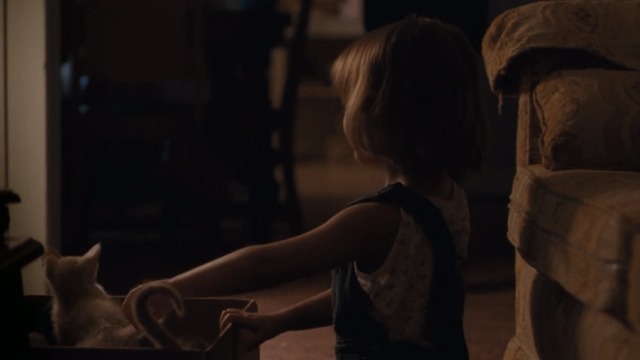
There's a fair supporting cast as well, from Charles Baker (Breaking Bad's Skinny Pete) as a bounty hunter after Bob, to Keith Carradine as the criminal/den father to our not-so-merry band of outlaws, to Nate Parker as an old associate and bar owner who aids Bob in securing false IDs and evading Patrick's snooping. Rami Malek, of the excellent Mr. Robot even shows up for a single scene where he plays a kid driving a car Bob hijacks. Overall the acting is good across the board, functional at worst and evocative at best. Part of that might be the box of kittens which shows up partway through, but I'm never one to complain about a box of kittens.

If that screengrab looks a little dark, good. It was a deliberate choice by the director to keep the lighting as authentic as possible to 1970s-ish Texas. There was apparently a strict rule during production to use only period-accurate lighting in an attempt to deliver the feeling of watching a series of old Polaroid reels unwind. They did such a good job that in some parts of the movie it's near impossible to determine what's actually happening, which apparently drove some conflict between Lowery and the studio.

The director's push for authenticity extends to the score as well, which is filled primarily with low strings and minor brass. For the most part the instrumentation feels absent; the primary use is a really wonderful bit over the early montage of Ruth's years apart from Bob and some tense string drones throughout, but for the most part the movie relies on the actors and visuals to set the tone. From the clouded-over Texas sky to the washed-out look of the film, it does a fair job capturing the feeling of watching a modern day fairy tale unravel around our characters.

Verdict

Ain't Them Bodies Saints is a competently made production with a good mix of first-time industry professionals delivering a story. If that seems a little noncommittal, there's a good reason, and it serves as my main critique of the movie, and the sole reason I wouldn't recommend it to everyone:

There are severe pacing issues and decisions with which I intensely disagree. In an effort to show us both Ruth's and Bob's sides of the story, the movie suffers in that it meanders during the middle 50 - 70 minutes. There's definitely something to be said for taking a slow pace and letting the movie unwind, but the only drive in the middle of the film is the exact circumstance of Bob reaching his family. While I can appreciate a character-focused drama, when you open and close with violent gunfights there needs to be a continuation of that threat throughout, rather than a single interaction between a shopkeep and a bounty hunter at the 45-minute mark.

Perhaps the best way to describe it is to evoke an exchange in the movie between Bob and Sweetie, played by Nate Parker. When describing how he'd delivered a powerful monologue about answering to God and the Devil for the things he's done and the prison doors swinging open, Bob's dramatic retelling grinds to a halt when Sweetie points out that the news reported him jumping from a work truck.

Overall, I enjoyed Ain't Them Bodies Saints as a proficient modern western telling the last story of this family. Unfortunately, I don't know that I can recommend it to everybody, simply because I feel like most people would lose interest at around the halfway mark.

The Saints: Acting from Affleck, Mara, and Foster shine through the overcast. I've seen a lot of people compare this movie to Terrence Malick, but beyond the efficient use of Texas openness, I don't quite see it. It's also nice to see someone de-romanticize the prison-break-find-the-family plot.

The Bodies: Usually I'm not one to wish for more mayhem when understatement works best, but I think adding a third gunfight to this would have served to truly elevate it.

The Ain'ts: Apparently the title is based on the director's misunderstanding of a song lyric. Considering the movie addresses the themes of redemption after death (if only a little) this feels a little like a writer's attempt to justify a title he thought sounded cool...not that I would know anything about that.

In other news, stay tuned for updates concerning my novel, Eight Days to Absolution. Wow, what a cool title, right? I wonder what it could refer to? Doesn't it just roll off the tongue?

Wednesday, July 13, 2016

A Tarnished Age; 1

Histandes’ foot caught on a loose stone, and he had just enough time to curse before he pitched forward. Long grass reached up to whip at him as he rolled downhill. His totem flew from his grasp and tumbled onward ahead of him. Through the chaos of his fall he heard the thumping footsteps of the pursuing fiend.
He came to a rest on his back at the base of the hill. With his vision reversed, the fiend’s long, curled horns twisted downwards like tree roots in clouded soil. From where he lay the stone atop the beast’s club seemed large as his head.
The weapon rose, and Histandes rolled away before it slammed into the ground in his place. He scrambled to his feet and ran to where his totem rested in the grass nearby. When he gripped the leather-wrapped handle his mind felt the three spirits kept within the stone. Phanael and Lassakim lay dormant within their seals, and Histandes knew awakening them would only invite their ire.
Balassu, however, was eager.
As the fiend approached, Histandes invited the spirit into his body and a new strength flowed up his limbs from the seal slotted into the totem. A grin split his face as Balassu flared to life in the space between his eyes, a fiery sigil which seemed to shiver with laughter.
The fiend swung its club in a low arc, but Histandes was already on his feet. The stone-topped weapon tugged at his clothing as it passed him by, and the shaman charged into the opening. He caught a glimpse of the fiend’s shocked face, nearly humanlike in its expression, before his totem cracked into the thing’s neck.
Histandes could feel Balassu’s satisfaction at landing such a blow, and the spirit’s eagerness to continue. The fiend reached around to crush the life from Histandes’ chest, but the shaman slid under the thing’s grip and struck again. His totem hit the fiend in the side, and the skin there split and cracked.
Balassu was elated at the bloodshed and the sound of the fiend’s pain and rage, and the spirit’s emotions crashed against Histandes’ mind like high tide. The shaman grit his teeth, ready to surrender himself to those urges should the fiend charge again, but the horned beast seemed unwilling to tempt more violence.
It was with a moment’s will that Histandes quelled Balassu, and the spirit’s fury at the interruption echoed as its presence left the shaman aching and tired. Though the spirit’s seal was faultless Balassu was of such a strength that its absence echoed through his limbs.
The fiend knelt nearby, club grasped defensively against another attack, and Histandes could see its inhuman eyes follow his totem. Then it spoke, “The thing gripped in your hand, a slur against nature’s order and the way of things.” Its voice was melodic and deep, like the far-off sound of thunder in the mountains, but an undercurrent of something altogether different laced the words.
Histandes inhaled and leaned on his totem. Its leather-wrapped grip was warm from recent use, and he could see wisps of steam curl from the fiend’s neck and between its fingers. The shaman knew the wound would take some time to heal, far longer than any injury his other weapons could cause.
“Naught but vermin ‘twixt the feet of giants,” the fiend said as it rose to its feet and began its way back up the hill. Histandes stayed still as it retreated, and the fiend kept his gaze all the way over the crest until its horns vanished from sight.
It wasn’t until the beast had left that Histandes let his breath rush from his chest. He was far more tired than he’d first suspected, and pulling Balassu from its seal had nearly proven a mistake. Even then the shaman could feel the spirit contend with the boundaries of its prison, though he knew they were secure.
With that thought in mind he turned again and moved down the hill towards the climbing smoke on the distant shoreline marking Port of Sharks. The harbor was the only city worth mentioning on Antuk, and the seat of the local High Speaker. The foothills soon gave way to a scrub forest, and Histandes gladly entered the trees. Fiends avoided the woods, where the low canopies and tangled branches snagged their horns and impeded their bulk.
He’d spent much of the past three moonturns in forests like these up in the Peaks on his mission to recall those living in those remote villages. Fiendish incursions into Man’s Reach had grown more and more violent over the past years, and the High Speaker had finally dispatched Histandes, the only shaman present on Antuk, to withdraw the most distant men under his watch.
Maybe a third of the villages he’d visited still showed signs of habitation, and even less recent. Of those few, even less were willing to take the risky trip down the mountainside to Port of Sharks, where they claimed the High Speaker would put them to work in the fields. Histandes hadn’t bothered to dispel that notion, partially because it was true, and partially because it wasn’t his place. A shaman carried the High Speaker’s word, without judgement and without change.
During his walk he came across a cluster of stonepit bushes and picked a handful to supplement his waning supplies. As he continued downhill he chewed at the fruit until the pits separated from the meat, and left the cores in a trail along his path. His totem rested on his shoulder, the spirits within quiet as twilight lowered above him.

Sunday, July 10, 2016

A Tarnished Age; 0

The Dayim’s fingers gripped the rocky ledge as he hauled his bulk onto the shelf. The mid-morning sun already beat upon his back like a lash, and he had succumbed to the temptation of Comfort and donned a head-wrap to protect the back of his neck from the heat. He would rather fast in penance for a day and a night than develop sunsickness. On his previous pilgrimage up to the High Peaks he’d gone uncovered, as was tradition, and his skin had cracked and oozed for days after.

The mountainside was much unchanged since the Dayim’s last ascension, but he kept a close eye for scree or weathering. Gwal’s last Dayim had never returned from his final pilgrimage, and his body was later discovered broken and picked at by scavengers at the mountain’s base. The man’s lack of faith and subsequent death meant his position remained unfilled for nearly a full moonturn, until the current Dayim forfeited his old name to lead the tribe.

He continued his climb, thankful to Gwal for his past life as a shepherd. The time had prepared his body for this hardship, and the muscles along his arms stood out underneath the coarse hair as he again pulled himself onto another rocky outcropping. The Turach stretched out behind him like a tan canvas, though he did not turn to look at it. Each moonturn he made the climb and each moonturn the Turach remained the same.

The Dayim allowed himself a small note of relief as he ascended the final stretch. For the most part the High Peaks were nearly sheer, with only the most subtle outcroppings serving as handholds. This last part of the mountain was a slope, however, and one shallow enough that he could march his way up, if he leaned his weight forward during. The wind grasped at his clothing, and carried with it the cold, bare scent of the mountains. Somewhere further north thunder echoed, though there was no way to know how near the storm was. The Dayim prayed Gwal would hold the clouds back long enough for him to conclude his business and find shelter in the crags for the night.

The gentle slope led to an outcropping which broke from the mountainside like the prow of a ship. Underneath his bare feet the Dayim could feel the smooth stone surface, worn of any imperfections by the weather. This time the Dayim did turn to look behind him. The steppe ran to the eastern horizon, and at the base of the foothills he could just make out the rest of the Gwalim’s encampment in small, dark brown patches against the tan.

After three days of climbing, he’d finally reached the point where his successor had fallen. With a prayer to Gwal he turned again and approached the altar. It rested atop the far end of the outcropping, a pile of loose stones cemented by weather and age into a roughly circular platform which reached his knees. A stunted tree, bereft of leaves, grew from the cracks between the stones, and the Dayim had to admire the plant’s tenacity.

As he approached he cocked his head in curiosity. The tree was a gnarled thing, bark craggy and wrinkled in a way that reminded the Dayim of the Sothna bed during the dry seasons. But it was the depression in the trunk that caught his eye, a disturbance in the otherwise consistent mottled browns. When he drew closer he saw it was a hollow, just large enough for his fist to plug. In the failing light he saw a round shape nestled inside.

He paused, his pilgrimage interrupted by the vision. There was no other one permitted to approach the altar, or even ascend the peak, other than Gwal’s Dayim, and he very much doubted the previous priest had left anything behind. The altar was Gwal’s to affect, and Gwal’s alone.

The Dayim knelt in front of the altar and reached a hand into the hollow to remove the object. Its surface was round, and slightly rough. Once taken from the hollow the Dayim saw it was a small earthenware pot, of the sort his tribe used to store foodstuffs. It was just large enough to rest comfortably in the palm of his hand, and he turned it over to inspect it.

The mouth was slightly raised with a lip, and around that lip was fastened a waxen seal. The Dayim thought he recognized it as beeswax, but couldn’t recall the last time he’d seen anyone in the Gwalim trade for the substance. The only peoples who kept the animals were the Nasirama, and they were far to the south in their stone towers.

He shook the jar, and something within rattled against the clay sides. He looked to the sky, eternally clouded and bruised this high into the Peaks, and when no sign came from Gwal, he used a fingernail to gently pry the wax from the mouth.

A sudden wind rose up around him, whipping at his robes and head-wrap, and the Dayim nearly lost his balance atop the outcropping. He upended the jar into his other hand, but nothing fell from the opening. The Dayim huddled lower by the altar as the wind increased in intensity, and he wondered briefly whether he’d been caught in a mountainstorm. Would the other Gwalim discover his body broken on the rocks below, another priest tested and found unworthy?

Gwal demands my faith, the Dayim thought as he straightened against the gale. He peeled the rest of the wax from the jar and looked inside to its empty exterior. Had the sudden wind snatched the pot’s contents from his notice? It was a possibility, though if that were the case his curiosity would remain unsated.

At that moment the Dayim’s back seized straight, and a vision clouded his mind:

A brilliance on the horizon
a bitterness in the waters
a Fiend among the Peoples

The Dayim heard a thunderous cracking sound and then silence. When he reached up to his ears his fingers came away coated red. The jar fell, forgotten, as he collapsed to his knees. The stone beneath him slumped and crumbled and eventually buried his broken body along the mountainside.

Sunday, May 15, 2016

Some Thoughts on "Curse of the Dragon Slayer"

"No guys, for real, this homebrew setting and
campaign is 100% original!"
Curse of the Dragon Slayer (2013)

Directed by: John Lyde
Produced by: Arrowstorm Studios
Written by: Jason Faller, Kynan Griffin
Budget: As expected for this sort of thing, I couldn't find any concrete budget information.

Starring: 
Richard McWilliams, Danielle Chuchran, Paul D. Hunt1

Lord of the Rings was a landmark movie in the realm of epic fantasy. Before Peter Jackson's shadow rose in the East the fantasy movie market really only existed in the 80s, with only a handful of entries in the genre achieving anything like widespread release. Some of those still endure, but the majority of those were easily dismissed as entries in a niche market that no one took seriously.

Nowadays you can't open a streaming service without mousing over a dozen low-budget fantasy titles featuring a party of adventurers of various demi-human races who have to save the world from an evil force by killing hordes of faceless bad guys and widowing who-knows-how-many faceless bad guy wives.

Curse of the Dragon Slayer is one of those movies, freely available to stream for anyone with an Amazon Prime subscription. I was browsing their selection when I saw the title and the poster, and you can bet that I judged this book by its cover. You've got a Fantasy Race Triangle, a 2-star dragon design, and obligatory orange-and-blue color scheme. I didn't have to scroll below this one before knowing what I was watching next.

When a mysterious Shadow cult rises and attempts to awaken an ancient evil, it's up to Female Elf Barbarian, Male Human Paladin, and Male Orc Fighter to defeat an army of CR 1 Shadow Cultists in order to prevent the rise of the god of death, Goth-Azul. Along the way we see one dragon, a few passable special effects, and plenty of B-grade fantasy schlock.

Now let's talk about this poster and analyze just how much it lies to us.

First off, the original title of this movie was not Curse of the Dragon Slayer...in fact, this movie has seven total titles...in English. If I included the foreign-language titles that number would climb to a full dozen. Here's a list of the English ones:
  • SAGA - Curse of the Shadow (Original)
  • Rise of the Shadow Warrior (UK English DVD box)
  • SAGA: The Shadow Cabal (Netherlands)
  • Curse of the Dragon Slayer (USA alternative)
  • Dragon Lore: Curse of the Shadow (USA alternative)
  • SAGA: Curse of the Shadow (USA English)
  • SAGA: The Shadow Cabal (World-wide alternative)
Behold, the chief and greatest of calamities!
Also, literally the first shot after the opening narration.
Why am I counting the title on the poster above as a lie? Well, it ties in with the three dragons portrayed, which is three times more than we see in the actual movie. The only dragon we actually see appears literally 90 seconds into the movie, and is promptly killed with a crossbow thirty seconds later.

Bard's got nothing on Nemyt
What follows is a surprisingly fine fight scene between an elf in spiky blue contact lenses and an orc that seems to have gotten lost on his way over from Mordor. The elf, Nemyt, beheads the orc but gets marked by a black symbol on her wrist.

After this we meet the Prophetess's Paladin, Keltus who, after visiting a dwarf friend of his and realizing he's also been infected by the Shadow, kills him with an explosive in a strange, misplaced attempt at slapstick humor. The dwarf design is actually pretty good, if a little jittery-looking. The movement is a little twitchy, but the prosthetic work is actually shockingly convincing.

It was during this scene that I realized just how derivative the movie might get. While up until this point everything shouted Lord of the Rings, the dwarf character is much closer to Warhammer or Warcraft in design, with goggles, a little tinkering workshop, musket, and love of blasting powder.

Finally, we meet Kullimon the Orc, who leads a band of warriors and raiders. He' delivering the Vessel (needed for Goth-Azul's resurrection) to...someone, and then it turns out his second-in-command is a shadow-guy and he runs off, leaving his horde under the Shadow's command.

After Keltus and Nemyt meet in the Dungeon of Plot Convenience they stumble across Kullimon in the Forest of Contrivances, and we have our adventurer's party. They travel along with their various subplots raising their ugly heads (Nemyt's mad, Keltus is faithful kinda, and Kullimon is proud) and eventually they vanquish the shadow cultists and return the world of SAGA to its semi-peaceful state.

The Nat 20s
If you turn your brain off and watch it as a D&D movie it's surprisingly passable. The fight choreography isn't terrible, even past the point where other movies stop putting in any effort. The amount of shaky camera and jump cuts is minimal, and it looks like they actually practiced hitting each other with their prop swords, as opposed to pulling their slashes. The first fight in the movie is still probably the best, but not by much.

Considering it's microbudget epic fantasy I was surprised at the overall quality. It's absolutely nothing special, but it had just enough high points to keep my interest over its running time. Part of this is the rarity of original epic fantasy content making it to the screen, and even though it's derivative I think there's enough room for more. Curse of the Dragon Slayer gave me an acceptable hit of epic fantasy that should keep me sated for a little while longer.

Acting is...mostly alright. Keltus puts on a fine show when the writing allows the character to emote, but in a lot of his scenes I was picking up some pretty strong Hayden Christensen-as-Anakin vibes. Nemyt is acceptable whenever she isn't growling like an animal, but those scenes aren't terribly common. The orc actors are having a great time, and Kullimon is obviously having a great time with the lines they gave him. This last one is a highlight, and any scene where Kullimon gets to actually do things elevates that part of the movie.

There are certain scenes that are actually pretty well done. In particular, there is a scene where Kullimon gets on a boat and stabs some mermaids. This scene is brilliant, and the best orc versus mermaid scene we'll likely ever receive. We also get some of the better "Communing with his deity" scenes I've watched in recent memory, where shooting location is utilized very well (salt flats, south-west badlands, etc).

Finally there's some small stuff that's kind of fun to see. One of the fight scenes features a troll of some sort that is portrayed by a man in a stilted costume that, although it's kind of goofy, actually has a physical presence in the world. Each of the orcs in Kullimon's horde is an extra in an orc costume, and the CGI is only ever used when necessary.

The Critical Fumbles
The CGI in several places is really...straight-to-DVD quality. Not only is it the quality of the textures/renders themselves, but it's the inconsistency in the designs. The dwarf characters, as said, are done with some surprising prosthetic work, which makes the decision to CGI their gunshots a strange one. Any time a dwarf fired a gun it looked like an early 2000s video game graphic. Finally, the design for Goth-Azul is just lazy, and doesn't help ward off any criticisms about derivative content; this god of death definitely took some cues from Blizzard's Diablo in appearance.

The derivative design doesn't stop at the dwarves or demons. The first appearance (and pretty much every one after) of an orc looked like the production designer raided WETA's workshop after Jackson finished the Hobbit trilogy. I kept expecting the orc players (using this word was an accident, but I'm keeping it because this movie is so obviously inspired by a D&D campaign) to shout "Man-flesh!" every time they were on screen. This doesn't apply to Kullimon, however, as his makeup instead looked like it was created by someone who read a description of Jim Carrey's Grinch makeup.

Do you have time to hear about Tarsa, our newest lord and savior?
Also, that's some pretty good looking chain, for real.
Story-wise this movie doesn't offer anything new, and at times it feels like they were rushing through a checklist of fantasy cliches in order to "complete" the plot. This extends to the subplots as well, though it applies especially to Keltus in particular. Throughout the movie we hear that his goddess, the Prophetess, doesn't care that Nemyt might die, as long as it leads to the Shadow's defeat. Keltus doesn't ever really have a scene where he worries about this until near the end, when he's beaten by the Shadow's right-hand-man in a sword fight and prays for deliverance...which is promptly rejected. We're led to think that Keltus might die, but then he appears a few scenes later with his paladin-tattoo replaced by the symbol of a different god (an "elder god," though there's no explanation of the difference between an Elder and a not-Elder god). There are a lot of moments like this in the movie, but this is the one that stuck out at me, because it makes the SAGA gods feel like they're little more than accessories. Most of these scenes could have been improved by including a single line of dialogue which explains it away, but all we have is a single appearance of a (secretly a goddess) beggar woman early on.

Amazon obviously used the wrong poster for this movie, based on the title and the fact that Curse of the Dragon Slayer is a different movie. The three characters are correct, but as said before the movie only has one dragon, which dies soon in. There are images of this movie's DVD case floating around the internet, and the blurb on the back is an outright lie. On the production company's website the name given is "The Shadow Cabal."

And finally, this might just be me, but there were certain establishing shots that used real-world geographic locations (the Grand Canyon, Monument Valley) which pulled me out of the movie. I know my thought process would have been something along the lines of, "Guys, people will obviously recognize this."

The GM Section
The production company responsible for this movie, Arrowstorm Entertainment, has a list of other movies they've produced here. Some of them, including Orc Wars and Survivor (starring...Kevin Sorbo? What?)  look like campy, awful, B-movie fun. Others look like fantasy schlock. Most of them look like they've been Kickstarted, which...hey, that's something.

I was curious why there were so many SAGA titles, and it turns out this is a movie set in a fantasy world used for a massively-multiplayer online real-time strategy game called...SAGA, where you play a fantasy nation and raise armies to conquer your neighbors. As a world-building enthusiast there wasn't anything new enough about the world to draw my attention to the game itself.

Should You Watch It?
Much like my opinion on Livin' by the Gun, this is one for mega genre fans, or people looking to watch a laughable movie with some friends. If you've ever played a D&D campaign or have any passing familiarity with the medium you might get something out of this.

Unlike Livin' by the Gun, this movie feels like it had some professional and financial weight behind it. While I almost admired Livin' by the Gun's team for its attempt, Curse of the Dragon Slayer comes far closer to fulfilling not only its genre obligations, but its obligations to the audience to provide entertainment of some sort.

Rating:
3/5 if you've already bought your Mordor*Con ticket
1/5 if the term "d20" means nothing to you